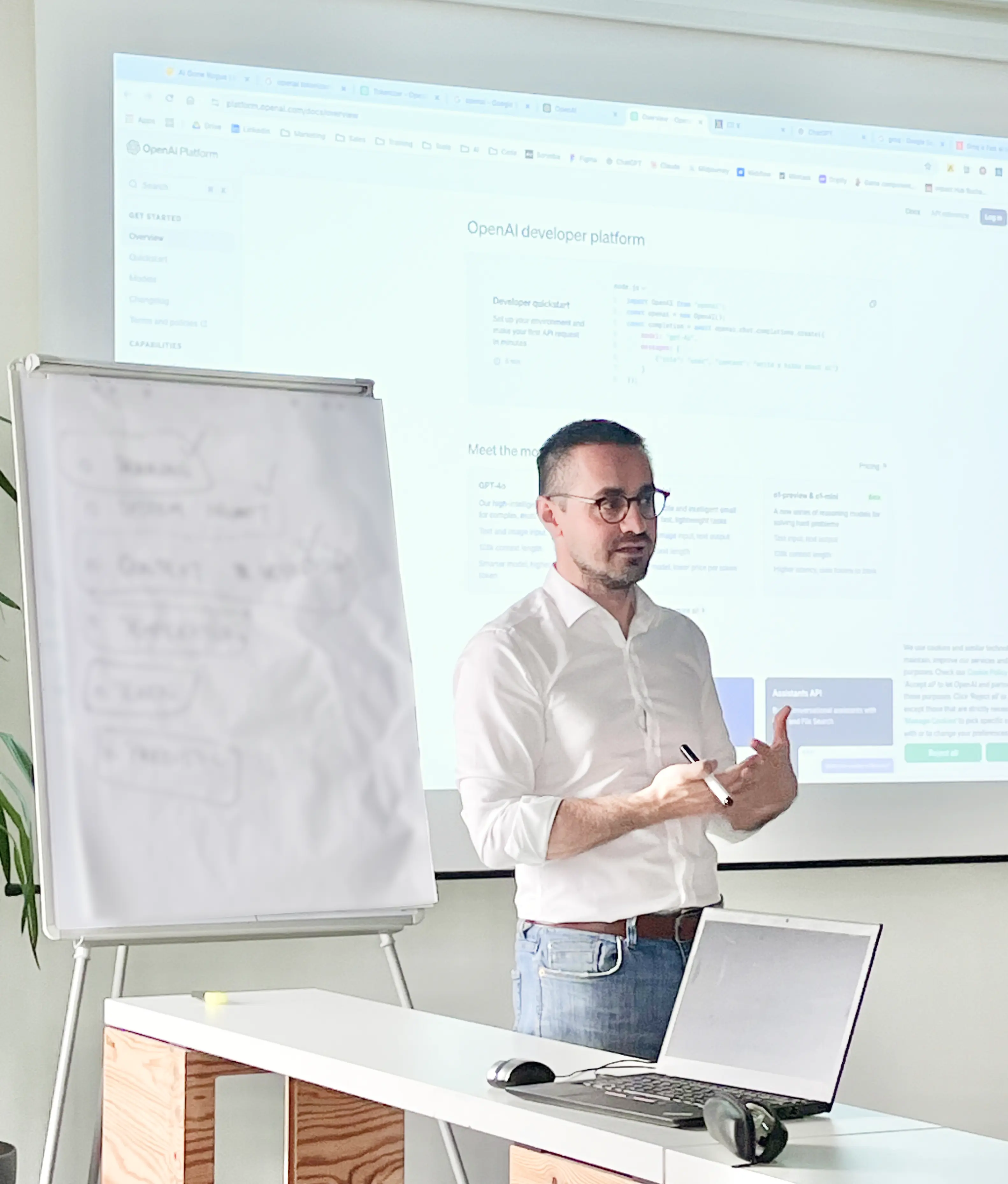
Most leaders learn AI by reading about it. The ones who keep up learn by doing it.
Programs that teach senior leaders to make AI decisions under pressure — governance, adoption, redesign of the work. Practice-based, built around your organization's real AI bets.
Practice the AI decisions before you have to make them..
Each program is anchored on the PolyCognitive Leadership framework — five levels of AI adoption, and the moves that get an organization through each.
Program 01Training · 2 days
PolyCognitive Leadership.
The framework, in practice. Two days for senior leadership teams to locate where their organization sits across the five levels, build the capability profile required at Level 5, and design the moves that get them there.
For
Executive committees · Senior leadership cohorts
Program 02Training · 1 day
AI Governance & Ethics.
For organizations starting to scale AI, where the governance gaps and ethical risks have begun to surface. One day to build the operating principles, decision rights, and escalation paths.
For
Risk, compliance, AI program owners
Program 03Workshop · 1–3 days
AI Discovery.
A hands-on workshop for organizations ready to find the AI use cases that actually move their numbers. The output is a use-case portfolio executives can fund — not another strategy deck.
For
Executive teams · Operations leaders · AI program owners
Program 04Workshop · 1 day
Leading Through AI Disruption.
For senior leaders whose teams' tools just changed underneath them. A working day on what's different, what isn't, and how to stop their organization atrophying while the system gets smarter.
For
Senior leadership cohorts · Function heads
How the work is built
Why most AI training fails.
I.
It's information, not practice
Most AI programs are tool tours dressed as leadership development. Tools change; judgment endures. Programs should train the second.
II.
It conflates levels
An organization at Level 1 needs different work than one at Level 3. A generic AI program treats both the same and lands at neither.
III.
It avoids the leadership question
AI is mostly a leadership question wearing a tooling costume. Programs that teach prompts without teaching judgment leave the actual problem untouched.
IV.
It doesn't show up to the room
AI moves weekly. A program designed in January and run in October is teaching last quarter's reality. Live cohorts beat recorded curricula.
V.
It optimizes for the wrong number
Engagement scores measure how a program felt. Behavior change measures whether the org moved a level. Different metrics, very different work.
Contact
If your senior leaders need to make AI decisions better, let's design the program.
Send a brief — where your organization sits on the adoption arc, the leadership cohort you have in mind, and the timeline. I reply within 1–3 working days.